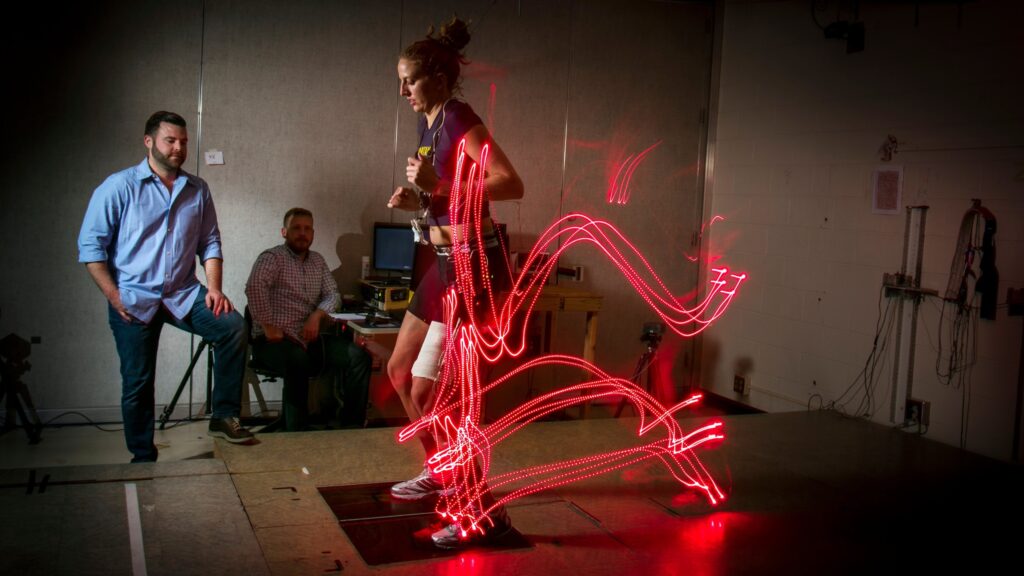
Human Movement Science and Sports Medicine
Human Movement Science and Sports Medicine areas integrate knowledge across the fields of Biomechanics, Motor Behavior, Sports Medicine, and Athletic Training. This collaborative environment prepares practitioners, researchers, and educators to reduce injury risk, return to normal function following injury or disease, and improve health and performance of physically active individuals of all ages.
M.S. DEGREE INFORMATION
The M.S. Program in Kinesiology with a concentration in Human Movement Science is primarily intended for individuals who wish to gain an advanced knowledge base in the areas of:
- Biomechanics
- Motor behavior
Additionally there is a heavy research emphasis with all students required to complete a thesis.
The M.S. Program in Kinesiology with a concentration in Sports Medicine is primarily intended for certified athletic trainers and other clinicians who wish to gain an advanced knowledge base in the areas of:
- Athletic training
- Sports medicine
- Biomechanics
- Motor behavior
PH.D. DEGREE INFORMATION
The Ph.D. Program in Kinesiology with a concentration in Human Movement Science is primarily intended to prepare individuals as academic researchers and faculty members in areas including:
- Athletic training
- Sports medicine
- Biomechanics
- Motor behavior
This track offers opportunities for teaching, mentoring, and research experiences through funded research, teaching, and clinical assistantships.
GOALS AND OBJECTIVES
GOAL 1
Produce highly competent practitioners, researchers, and educators and who possess the knowledge and skills to be distinctly competitive in the job market, and who appreciate and value their roles as contributing professionals in larger communities of Kinesiology and Health Care.
OBJECTIVES
- Offer quality educational programs through UNCG´s Department of Kinesiology that prepare masters and doctoral level students for careers in athletic training and sports medicine, biomechanics, motor control and related disciplines.
- Provide teaching assistant and mentoring opportunities for doctoral students through the undergraduate kinesiology degree and entry-level graduate athletic training concentration.
- Provide research assistantships and training for undergraduate and graduate students in biomechanics, sports medicine, motor behavior and related disciplines.
- Promote professional development through student involvement in local, regional and national professional meetings and activities; providing networking opportunities with nationally recognized scholars and clinicians through invited lectures; engaging in dialogue that promotes understanding of current professional and employment practices; and mentoring students in the dissemination of their research through abstract presentations at appropriate professional meetings.
GOAL 2
Improve the health and performance of the physically active across the lifespan through research and education.
OBJECTIVES
- Promote scientific inquiry leading to clinical knowledge. This includes, but is not limited to:
- Developing and applying objective, quantifiable metrics that accurately index functional mobility
- Creating virtual reality applications specifically designed to restore functional mobility
- Identifying and intervening on risk factors of lower extremity injuries with an eye towards long-term prevention programs.
- Collaborate with area clinicians to promote clinically applied research that bridges scientific inquiry with clinical practice.
GOAL 3
Promote and support student and faculty initiated research activities in a collaborative, multidisciplinary environment.
OBJECTIVES
- Promote the undergraduate research mission of the University by securing undergraduate research assistantships and partnering undergraduate students with graduate student and faculty mentors on ongoing research activities.
- Conduct regular laboratory meetings to communicate research ideas and scientific findings, to critically examine the literature, and to initiate collaborative projects.
- Identify faculty / student research teams to address and advance the laboratory research agenda.