Posted on September 23, 2024

Featured Image for Congratulations to Our Newest EdD in KIN Graduates

In May, we hosted the Dissertation Showcase at Union Square. Our graduating students shared the key takeaways from the dissertation work through their visual abstracts and a short presentation in one of four categories (education and coaching, college populations, special populations, and physical activity impacts). This led to some great conversations with attendees. It was wonderful to hear how the students’ dissertation work is making an impact.


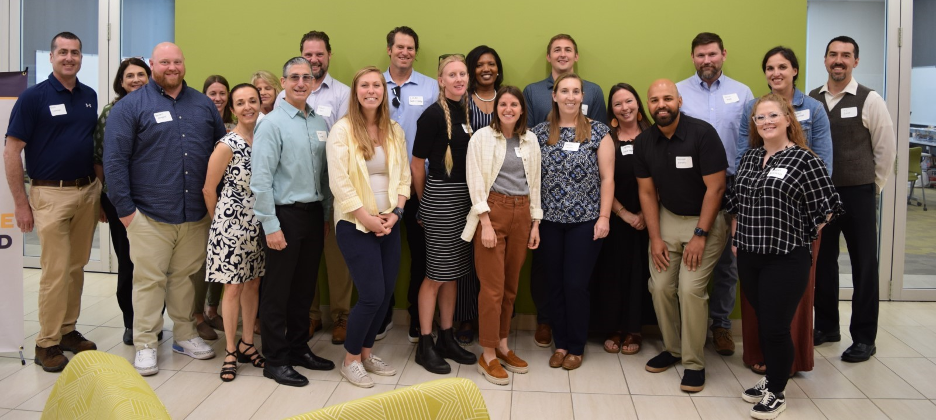
Group of people posing in front of a wall
Group of people in front of a wall

We celebrated the accomplishments of the group and their upcoming graduation at Oden’s Brewery. Family and friends joined the festivities for an evening of smiles and laughter. 

Group people sitting at a table
Group of people sitting at a table
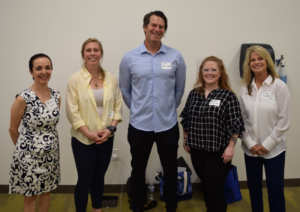
Group of women posing for a photo

We had 20 students graduate with their Doctor of Education in Kinesiology (listed below). In addition, three of our graduate assistants earned their master’s degrees. Maggie Best graduated with her Masters in Kinesiology with a concentration in Sports Medicine. Agustin Saldana graduated with his Masters in Kinesiology with a concentration in Exercise Physiology. Jane Bodinger graduated with her Masters in Sport and Exercise Psychology. We are super thankful for their hard work and will miss them! Congratulations to all our graduates!!!
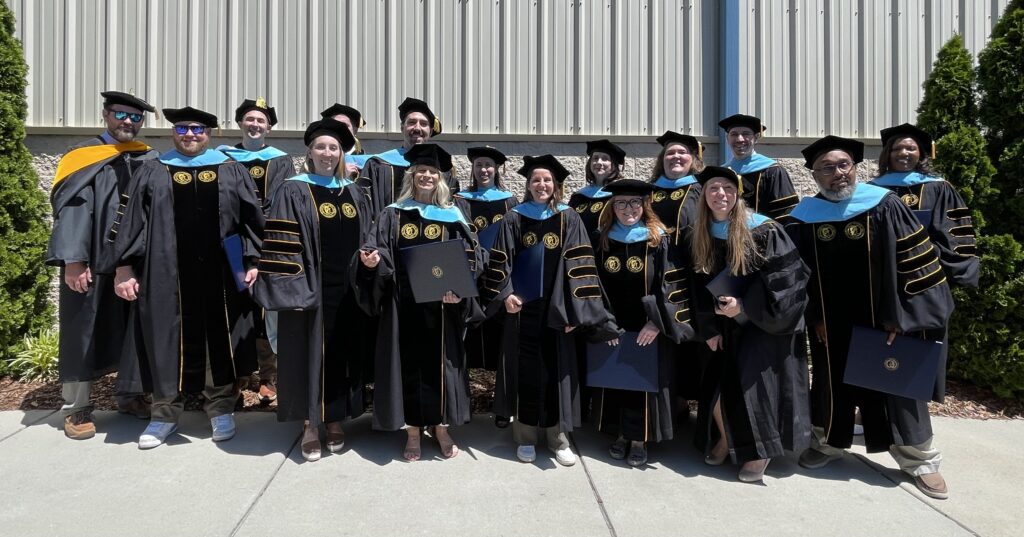
Class of 2024 Graduates

Katie Baur

Amanda Bireline

Justine Boggs

Devin Cashman

Kirstie Vitatoe

Donovan Dinson

Mona Flynn

Marek Gaddy

Aslynn Halvorson

Loretta Holmes

Sabrina Johnson

Tyler Johnston

Alessa Lennon

Mandy Northcutt

Kara Schwab

Brian Sutton

Jenny Thornton-Brooks

Brandon Warner

Garrett Wingate

TJ Zinke

Visit the EdD in KIN website for more information about the program.

Posted on September 03, 2024

Kinesiology Professor Receives National AASP Award

 Kinesiology professor Dr. Alan Chu was selected for the 2024 Association for Applied Sport Psychology Dorothy V. Harris Memorial Award. The award is given to professionals early in their careers who are impacting sport psychology.

Posted on August 27, 2024

Conference Room

PAC Lab Article Written By Kylie Kayser

The 2024 Alzheimer’s Association International Conference (AAIC), held July 28th to August 1st in Philadelphia, PA, brought together thousands of researchers, clinicians, and leaders from around the globe to share groundbreaking research and innovations in the field of Alzheimer’s disease and dementia. More than 14,000 people gathered to learn about the research being done on Alzheimer’s and dementia. Members of the Physical Activity and Cognition Lab were in attendance and presented findings from the Physical Activity and Alzheimer’s Disease II (PAAD2) study. Check back soon for an article with details and more pictures of our team.

The conference highlighted key developments in diagnostics, treatment, risk reduction, and the social impact of these Alzheimer’s disease and dementia. Here are some highlights from the conference:

  • Lund University researchers have made strides in developing blood tests that detect Alzheimer’s early by using biomarkers to identify individuals at risk before symptoms manifest. This breakthrough could revolutionize diagnosis by making it more accessible and enabling earlier treatment.
  • A 10-year California study linked wildfire smoke and air pollution to an increased risk of dementia, with wildfire smoke being particularly hazardous. These findings emphasize the seriousness of wildfires and the need for public health strategies to alleviate these risks.
  • Researchers at Imperial College London found that Liraglutide, a diabetes drug, may slow cognitive decline in Alzheimer’s patients by reducing brain shrinkage in areas responsible for memory, learning, and decision-making. This suggests a potential new treatment pathway targeting brain metabolism.
  • Harvard researchers emphasized the role of diet in dementia prevention, finding that processed red meat increases the risk, while replacing it with nuts or legumes can lower it. Heart-healthy diets were shown to protect against cognitive decline, highlighting the importance of nutritional choices for brain health.

If you’re interested in learning more about the exciting discoveries shared at the 2024 AAIC, visit https://aaic.alz.org/highlights2024.asp.

Posted on July 27, 2024

Women Smiling

PAC Lab Article Written By Brittany Armstrong

Ever heard the saying, “Use it or lose it”? It turns out that this old motto is pretty accurate when it comes to keeping our brains healthy. One of the best ways to keep your mind sharp as you age is to stay socially active. Let’s dive into why chatting with friends and staying connected might be a defense against dementia.

Keeps Your Brain Busy. When you’re socially active, you’re constantly using your brain. From remembering names and faces to keeping up with conversations and understanding social cues, these activities help keep your mind sharp. Research published in Cognitive and Behavioral Neurology found that people who are socially active tend to have better cognitive performance (Fratiglioni, et al., 2017). Regular social interaction may help maintain brain function by providing ongoing mental stimulation.

Reduces Stress. Being with friends and family can lift your mood and reduce stress. High stress can damage your brain over time, leading to inflammation and increased risk of cognitive decline. Research published in JAMA Psychiatry shows that strong social support can buffer the effects of stress and maintain cognitive function (Zautra, et al., 2020). Participating in social activities may help protect your brain.

Boosts Mental Health. Mental health and cognitive health are closely intertwined. Social engagement can improve mood and reduce depression and anxiety, both of which are linked to a higher risk of dementia. Research published in The Lancet Psychiatry found that people with robust social networks are less likely to experience depression (Roberts et al., 2019). Maintaining social connections may contribute to better cognitive health by enhancing overall well-being. Social interactions can make you feel happier and more connected, which is good for your overall mental health. And a happy mind is a healthier mind!

Facilitates Learning. Social interactions often involve learning new things and adapting to new situations, which helps keep the brain flexible and adaptable. Research published in Neuropsychology Review suggests that engaging in diverse social activities and learning new skills helps preserve cognitive function and protects against dementia (Schofield, et al., 2021). By consistently challenging the brain, we may be able to enhance cognitive resilience and reduce the risk of cognitive decline as we age.

Social engagement is a powerful tool for maintaining cognitive health and reducing the risk of dementia. By keeping your brain active, managing stress, boosting mental health, and facilitating learning, staying connected with others offers a versatile approach to brain health. Socializing provides a fun and effective way to help keep your mind sharp and resilient as you age. So, get out there, stay connected, and enjoy the company of others. Your brain will thank you for it!

Posted on July 30, 2024

Adam Berg

As this year’s Summer Games get underway in Paris, the story of the failed (1976) Denver Games is a reminder for public officials and residents alike. Coloradans won and then banished the Olympics. Yet the question at the heart of the “Denver ’76” controversy was not simply whether to host the Games. It was a matter of what the future of Denver and Colorado should be.

Posted on April 30, 2020

Phone Call Away Featured Image

First came the request to limit visits to the retirement community. Next caregivers were screened before entering and asked to only come for essential visits. Now no visits are allowed under any circumstance.  

While each new level of social distancing is necessary and appropriate, every additional layer increases social isolation for older adults living in extended care facilities or nursing homes. Caregivers must replace usual visits with a phone call which can be particularly challenging when communicating with someone with dementia. Without the usual visual cues and hands-on assistance, caregivers have to be more perceptive than ever during conversations. 

To help make calls as beneficial as possible, it’s good to take a quick refresher from the National Institute on Aging on the basics of communication challenges caused by dementia. 

Here’s a few common issues experienced by your loved one with dementia: 

  • Trouble blocking out background noises like the radio, TV or conversations: Ask your loved one to move to a quiet place or ask staff members to help ensure your elderly loved one is in a quiet place and has turned off the television 
  • Finding the right word and losing train of thought when speaking: Ask questions that require a yes or no answer instead of open-ended questions. If they struggle to find the right word, they might need a prompt or two to help, but avoid quickly finishing their sentences for them – make sure they have the chance to express their own thoughts.  
  • Understanding what words mean: If they do not understand the first time you say something, try re-phrasing.  
  • Processing a large amount of information, following a long conversation, or remembering how to do basic activities: If you need to explain something or give instructions, offer information in a simple, step-by-step way. It may help to re-send information or instructions in an email to your loved one or to a staff member if that is possible. 
  • Frustration with communicating: It can be hard to keep repeating things but try remembering how hard it is for them before you say, “I just explained that” or “we spoke about that 5 minutes ago.” More now than ever, they need you to listen and be patient.  

A silver lining to stay–in–place orders is that many people have more time in their schedule. Now is a great time to encourage other family members and friends to call your older loved one. Be sure to share these pointers if they don’t have experience talking to people with dementia. 

Posted on July 02, 2020

Alois Featured Image

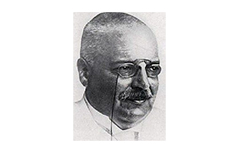
With this first Throwback Thursday we honor Dr. Alois Alzheimer. In the early 1900s, Dr. Alzheimer described two cases, those of Auguste D. and Johann F. These are some of the first cases where a major difference was noted between dementia and what, at the time, was known as presenile dementia. The in-depth description of the disease in the report on Johann F. has justified the credit given to Dr. Alzheimer for his work in recognizing the disease as a separate condition from dementia (Möller & Graeber, 1998).

Posted on July 16, 2020

Beta Amyloid Featured Image

For this week’s Throwback Thursday we would like to remind everyone of the ground-breaking work of Drs. George Glenner and Caine Wong, the scientists who first discovered beta-amyloid in 1984. Beta-amyloid is a protein which is the primary component of Alzheimer’s plaques. For more information see this link. The discovery of Glenner and Wong served as a significant milestone in Alzheimer’s research and beta-amyloid remains an important target for prevention (Glenner & Wong, 1984; Alzheimer’s Association, 2020).

Posted on August 13, 2020

Tau Protein Featured Image

This week’s Throwback Thursday is a chance to learn about the Tau protein, discovered in 1986 by Dr. Grundke-Iqbal and her team. The tau protein is a protein present in brain cells that, when modified due to disease, becomes a key component of neurofibrillary tangles. Since the tau protein continues to build-up throughout the entire course of the disease (unlike beta-amyloid plaques) it is used to judge disease stage and severity (Grundke-Iqbal et al., 1986; Ellison, 2019; Alzheimer’s Association, 2020). To learn more, click here.

Posted on September 17, 2020

APOE Featured Image

Apolipoprotein E (ApoE) is a unique protein in that it helps to maintain and improve neuron cells when necessary. ApoE is heavily implicated in Alzheimer’s disease, with its contribution to plaques and its reduced presence in the hippocampus of Alzheimer’s patients. The ApoE protein is encoded by the APOE gene. The variant of APOE that has become a matter of research interest in Alzheimer’s is the ɛ4 allele. Poirier et al. (1993) revealed an increased presence of this allele in individuals with Alzheimer’s. It is important to note, however, that there were participants in the study with the ɛ4 allele who did not have Alzheimer’s and participants with Alzheimer’s who did not have the ɛ4 allele. Therefore, while this allele may have some impact on Alzheimer’s chances, its true influence may be determined by other genetic factors or by lifestyle behaviors (Poirier et al., 1993).

You can find the original research article here!