Posted on November 15, 2024

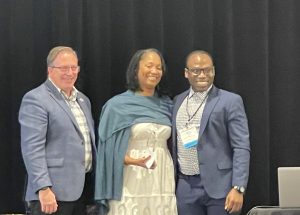
Mona Flynn and the Conference Director for the Midwest Yoga Conference

In October, Dr. Mona Flynn, a 2024 graduate of the Ed.D. program, had the opportunity to present her research at two yoga conferences: the Symposium on Yoga Research and the Midwest Yoga Conference.

The Symposium on Yoga Research (SYR) was held on October 14 -16, 2024 at the Kripalu Center for Yoga and Health in Stockbridge, Massachusetts. The SYR is the academic conference for the professional organization, International Association of Yoga Therapists. Mona’s poster was titled Impact of a Community-Based Yoga Program on Quality of Life for Immigrant and Refugee Women. Mona was encouraged to submit her research for publication and to seek grants to continue her research. Mona credits Dr. Diane Gill, Dr. Pam Brown, and the Ed.D. in KIN program for preparing her for the presentation. She credits her dissertation work for not only helping her to gain valuable research experience, but also improve her business, Life Fit Yoga. Learning about qualitative research methods, such as Sort & Sift and Think & Shift (Maietta et.al, 2021), boosted her confidence in sharing how these qualitative research methods align with the profession of yoga therapy and the desire to grow research using these types of methods.

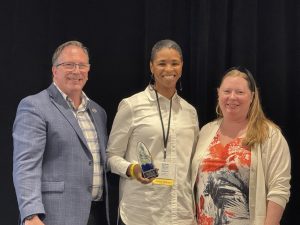
Additionally, Mona was the keynote speaker at the Iowa Midwest Yoga Conference on October 26, 2024. The theme for the conference was “Inclusion”, which fit with Mona’s work with the community program, The Yoga Connection. She was excited to share her passion for the community program, her research, and encourage replication of such programs that are tailored to the needs of underserved populations. Mona shared that “every single course (in the Ed.D. in KIN program) provided insight which moved the needle forward in this community program I founded.” Coursework in program design, strategic planning, effective leadership, and more guided her program development, including becoming a non-profit. Furthermore, Mona believes that incorporating research into a community program is a great way to bring together healthcare, physical education, community enrichment, and successful resettlement.

Mona Flynn hopes to continue her work as as she finds her way in community-engaged research.

Visit the Ed.D. in KIN website to learn about how the program can help you make a community impact.

Posted on November 26, 2024

person making emergency plan

PAC Lab Article Written By Kylie Kayser

Natural disasters like tornadoes, hurricanes, blizzards, fires, and floods can be stressful and unpredictable for anyone. For caregivers of individuals with Alzheimer’s disease, emergencies add an extra layer of complexity. Disruptions to routine can lead to increased confusion, agitation, behavioral change, or wondering, making it even more critical to be prepared. Knowing how to properly prepare can reduce stress and ensure the safety of your loved ones.

Tip 1. Build an Emergency Supply Kit

A well-stocked emergency kit is essential in times of crisis. Make sure your kit includes:

  • Medication and Medical Information: Keep a 7-day supply of medications and a list of medication names and dosages. Include a summary of medical history, physician contact information, and copies of IDs and insurance cards.
  • Personal Care Essentials: Pack hygiene items, extra clothing, mobility aids, and any other necessary care items.
  • General Emergency Supplies: Make sure to have flashlights, batteries, bottled water, non-perishable food, and a first-aid kit on hand.
  • Caregiver Needs: Include things like a phone charger, ID copies, cash, and a list of emergency contacts.

Store this kit in an easily accessible location and make sure to check it often to make sure medications and supplies are up to date.

Tip 2. Anticipate Behavioral Changes

Disruptions to routine can lead to increased confusion or distress for individuals with Alzheimer’s or dementia. During emergencies, be mindful of potential changes. Preparing for and responding to these changes can make the situation more manageable:

  • Stay Calm: Your loved one may sense your emotions and mirror them. Maintaining a calm demeanor can help them feel more at ease.
  • Maintain Structure: Preserve as much of their daily routine as possible. Incorporate familiar elements to create a sense of normalcy.
Tip 3. Share Essential Information

Since emergencies are unpredictable, ensuring others are informed and prepared to step in when needed is vital. Share key details about your loved one with trusted individuals, such as:

  • A Detailed Care Plan: Include routines, dietary preferences, and notes on behavioral patterns.
  • Emergency Contacts: Provide a list of family members, friends, and physicians to contact in an emergency.
  • Updated Medical Information: Share diagnoses, medications, medical history, physician details, and any known allergies.

Emergencies can be overwhelming, but preparation makes all the difference. By building a comprehensive plan, sharing essential information, and offering emotional and physical support to your loved one, you can navigate these situations with confidence and care.

Posted on November 15, 2024

Man in a suit

On November 11, 2024, Dr. Robert Owens, a 2011 graduate of the Ed.D. in KIN program, led a stress and wellness workshop for undergraduate and graduate students as part of the KINclusive programming.

During the workshop, students learned the importance of stress management and how it impacts daily life, engaged in a deep breathing activity, and were encouraged to have an abundance mindset. Dr. Owens shared his experience working with O2X Human Performance where he presents workshops on stress and wellness, and leadership communication in high-stress and high-risk work environments. Students enjoyed the workshop as they were able to share and develop strategies to help manage stress in their daily lives such as going for a walk, engaging in their favorite activity (i.e., listening to music, watching a movie, reading, painting, etc.), and using the tactical pause technique.

Dr. Owens is a leadership and resilience coach and provides services to leaders in healthcare, academic medicine, corporations, and tactical settings (i.e., first responders, military, and government entities). He is a certified leadership and organizational development coach, a licensed counselor, and a Certified Mental Performance Consultant®.  He currently serves as the Division Head for Research and Practice for the Association for Applied Sport Psychology. He is one of the founders of the association’s MMA and Combat Sports (2023) and Men & Masculinities (2018) Special Interests Groups. Additionally, he is an adjunct faculty member in the UNCG Department of Kinesiology.

Visit the Ed.D. in KIN website for more information about the program.

Posted on November 07, 2024

Laura Turek, a 2023 EdD graduate, is now an Assistant Professor of Health Sciences, Sports Medicine, and Athletic Training and the Program Director for the Master’s in Applied Kinesiology at St. Thomas University in Miami Gardens, Florida. She teaches in the undergraduate and graduate Health Sciences program and the undergraduate Sport Administration program. Dr. Turek enjoys this position because it allows her to teach in a variety of areas and use her background in Sports Medicine and Sport Administration.

Laura is most excited about mentoring her students. Many of her students are part of the Applied Kinesiology master’s program with concentrations in Human Performance or Coaching, which she helped establish. She credits the curriculum planning course and seminar courses she took in the EdD program with preparing her for her new role. Laura is an advocate for sport participation for people with ADHD and presented her dissertation research on Parental Perspectives of Sports Participation at the Children and Adults with Attention-Deficit/Hyperactivity Disorder (CHADD) Annual International Conference on ADHD in November 2023. 

Laura wants others to know that “the connections you make at UNCG in the EdD program are not just professional” and emphasizes the importance of maintaining these connections. She values these connections and knows that she can depend on her professors and peers for continued mentorship and advice. She applies what she learned in the EdD in KIN program at UNCG as a guide to her mentorship and teaching. 

Visit the EdD in KIN website to learn more about the connections you can make in the program. 

Posted on November 04, 2024

Kinesiology students conduct research in the sport and exercise psychology program.

There is strong scientific evidence that the risks of engaging in moderate-intensity exercise during pregnancy are very low for healthy individuals. Moreover, physical activity during pregnancy benefits a pregnant woman’s overall health.

Kinesiology Professor Dr. Jaclyn Maher.

Posted on October 31, 2024

Woman in a graduation gown

EdD in KIN alumna, Brittany Belcher, secured a position at The University of Virginia’s College at Wise as an Assistant Professor of Kinesiology! She teaches a variety of classes from Biomechanics, Teaching Team and Individual Sports, Applied Assessment in Kinesiology and will be teaching a Sport Governance class in the Spring. Her story is inspiring because she is a first-generation college graduate from UVA-Wise. Brittany believes being a Wise County native made her a good fit for the position. Her 10-year background in the public school system as a Physical Education teacher provides real life experiences she can share with her students. She is looking forward to making connections and having a new avenue to complete and present her research interest.

Brittany had the opportunity to give two presentations at SHAPE America in Cleveland last Spring, “thanks to the connections [she] made at UNCG while completing research.” To this day, she is using the networks from the EdD program to continue and present research. Brittany, Dr. Dyson, and others from various cohorts have submitted a proposal to present at SHAPE America in Baltimore in 2025. The EdD program has opened many doors for Brittany. She is “forever grateful for the friendships and connections made from [her] time as a student at UNCG.” This program transformed her teaching. She fueled her passion for teaching based on her research interests that she followed throughout her time in EdD program. Brittany now implements those strategies into her new position. 

Visit the EdD in KIN website to learn more about how the program can do the same for you.

Posted on October 30, 2024

In May 2024, the graduating class of the Doctor of Education in Kinesiology program presented their doctoral research to their peers, Kinesiology faculty members, and others during the Dissertation Showcase. The students designed the visual abstracts to share their findings and the implications of the work with the community to help others use the findings in their own settings.

Click the images to see larger versions of the infographics and use the links provided to read more about these exciting research projects!

Katie Baur

Weight Training Practices and Perspectives among Cadet Women at a Senior Military College

Read the full abstract

Amanda Bireline

The Effect of Wearable Activity Tracker Social Behaviors on Moderate-to-Vigorous Physical Activity and Exercise Self-efficacy

Read the full abstract

Justin Boggs

The Effect of an After-School Outdoor Adventure Education Intervention on High School Students’ Outdoor Recreation Perspectives 

Read the full abstract

Devin Cashman

Adoption and Use of Virtual Reality Technology for Endurance Sport by College Students

Read the full abstract

Donovan Dinson

Student Choice and Voice in Physical Education

Read the full abstract

Mona Flynn

The Impact of a Community-Based Yoga Therapy Program on Quality of Life for Immigrant and Refugee Women

Read the full abstract

Loretta Holmes

Home Exercise Program Adherence in Patients with Low Back Pain

Read the full abstract

Sabrina Johnson

Mental Health Resources Available to Community College Athletes

Read the full abstract

Tyler Johnston

Knowledge and Use of The Therapeutic Relationship in Physical Therapy 

Read the full abstract

Alessa Lennon

Burnout in College Football Players: Prevalence and Change Over a Competitive Season 

Read the full abstract

Mandy Northcutt

An Exploratory Study on Factors that Impact Children with Autism Spectrum Disorder’s Physical Activity 

Read the full abstract

Lucas Salles-Cunha

Understanding Water: Values, Viewpoints and Behaviors that Influence Swimming Participation in Watsonville, CA. 

Abstract coming soon

Kara Schwab

Sports Participation as Protective Factors in Student-Athletes that have Attended Sherman Indian High School, an American Indian Off-Reservation Boarding School

Read the full abstract

Brian Sutton

Career Readiness of Individuals Obtaining an Accredited Personal Training Certification and Suggestions for Professional Education

Read the full abstract

Jenny Thornton-Brooks

Why Those with Chronic Low Back Pain Engage in Physical Activity

Read the full abstract

Kirstie Vitatoe

Physical Activity and Health: An Agrarian Perspective 

Read the full abstract

Garrett Wingate

An Examination of North Carolina High School Football Coaches Relative to Football Helmet Fitting 

Read the full abstract

TJ Zinke

Early Sport Specialization and Chronic Injuries in College Students

Read the full abstract

Posted on September 23, 2025

You’re invited! UNCG Kinesiology is holding in-person and virtual open house events in October and November for prospective students to learn more about our many graduate programs.

  • Learn about our graduate programs
  • Tour our labs
  • Meet faculty and students
  • Gain application tips

Learn more about our graduate degrees and areas of study.

MSAT Program, In-Person

Coleman Building, Room 347

Learn about our Master of Science in Athletic Training program and get tips about the application process.

ALL GRADUATE PROGRAMS, IN-PERSON

Coleman Research Gym – Coleman Building, Room 248

ALL GRADUATE PROGRAMS, VIRTUAL

Posted on October 09, 2024

Picture of MRI and MRI Computer

PAC Lab Article Written By Brittany Armstrong

Dr. Sam DuBois, a dedicated member of the Physical Activity and Cognition Lab, recently earned her Ph.D. in Kinesiology under the mentorship of Dr. Jenny Etnier. Dr. DuBois has been an invaluable asset to the lab, recognized by research participants for her kindness, admired by classmates for her reliability, and respected by faculty for her intelligence.

In her final year of graduate studies, Dr. DuBois undertook her dissertation—a comprehensive research project based on her own questions. This accomplishment involved designing and conducting her own study, authoring a 50,000-word paper, and successfully defending her work in an oral examination.

Dr. DuBois’s dissertation, titled “Acute Exercise and Pattern Separation-Dependent Mnemonic Discrimination in Older Adults: An fMRI Investigation,” investigates the effects of moderate-intensity exercise on the mnemonic discrimination performance and brain-wide activity of older adults. Below, Dr. DuBois explains key terms from her title, discusses the significance of this research, and shares her study’s findings.

Definition of Terms

  • Acute Exercise: A single session of exercise.
  • Mnemonic Discrimination: Episodic memory is a type of memory that involves the recollection of personal experiences or events, including the time and place they occurred, such as remembering details of your wedding day. Mnemonic [ni-mon-ik] discrimination is a crucial component of episodic memory that allows us to differentiate a current event from memories of similar past events.
  • fMRI: fMRI stands for ‘functional magnetic resonance imaging’ or ‘functional MRI’. This type of MRI scan can show which areas of the brain are most active.

Importance of Study

As people age, mnemonic discrimination declines. This makes older adults more likely to misremember details of routine events, such as taking medication or recalling where they parked. Therefore, effective strategies to reduce the severity of age-related declines in mnemonic discrimination are needed to support the daily functioning of older adults.

Physical activity has been shown as a lifestyle factor that can benefit cognitive function in older adults, helping to protect brain regions that facilitate the neural processes that underlie mnemonic discrimination. However, research using precisely designed mnemonic discrimination tasks sensitive to these age-related changes remains limited.

Since the rapid physiological responses to a single session of exercise (acute exercise) may accumulate over time to create long-term brain and cognitive changes, acute exercise studies that use mnemonic discrimination tasks are ideal. They can address the existing gap in the literature and guide the development of chronic exercise programs aimed at age-related declines in mnemonic discrimination.

Thus, the current study included 26 physically active, older adults (average age = 65.5) who attended 2 lab visits approximately 1 week apart.

  • Completed a mnemonic discrimination task during a functional MRI scan after seated rest (20 minutes of resting while sitting on a stationary bike)
  • Completed a mnemonic discrimination task during a functional MRI after acute exercise (20 minutes of moderate-intensity aerobic exercise riding a stationary bike)

Results and Findings

Results showed that performance on the mnemonic discrimination task following acute exercise and seated rest did not significantly differ. However, functional MRI scans showed that brain activity in specific regions was reduced following acute exercise compared to seated rest. Specifically, during task trials that required mnemonic discrimination, where participants viewed lure objects that were similar to previously seen objects, brain activity in regions of the ventral visual cortex that are important to episodic memory was reduced following acute exercise compared to seated rest.

These results suggest that although acute exercise (a single session of moderate-intensity exercise) may not enhance behavioral mnemonic discrimination in older adults, it can improve neural efficiency in ventral visual regions as fewer neural resources are needed to maintain the level of mnemonic discrimination performance. Thus, acute exercise may induce short-term, beneficial changes in the function of brain regions that support mnemonic discrimination.

Future research is needed to understand how acute exercise-induced change in the function of ventral visual regions may relate to changes in brain function and mnemonic discrimination performance of older adults after chronic exercise interventions.

Dr. DuBois’s work adds to a growing body of research on the benefits of physical activity for cognitive health in aging, highlighting how even a single session of exercise can positively influence neural efficiency in older adults. While her findings indicate that acute exercise may not immediately enhance mnemonic discrimination performance, the reduced neural activity in key brain regions suggests that exercise may support cognitive function by requiring fewer resources to achieve the same level of performance.

Dr. DuBois completed her dissertation and graduated from the UNC Greensboro Department of Kinesiology in May 2024. She is currently an Assistant Professor in the Department of Public Health and Exercise Science at Appalachian State University. If you have any questions about her research, you may contact her by email at duboissl1@appstate.edu.

Posted on October 10, 2024

Man giving a speech.
Dr. Dyson provides the New Fellows’ response.

On September 28, Dr. Ben Dyson was inducted into the National Academy of Kinesiology (NAK) as 2024 Fellow. The NAK is a prestigious organization with 100 years of rich history contributing to the area of Physical Education and the discipline of Kinesiology.

Dr. Dyson is a Professor in the Department of Kinesiology at the University of North Carolina at Greensboro. He is an internationally recognized scholar in Health and Physical Education in the areas of innovative curriculum and pedagogy, Cooperative Learning (CL) as a pedagogical practice, and scholarship in Social and Emotional Learning. Currently, he is partnering with Guilford County School teachers and students on his research. Dr. Dyson has taught at McGill University in Montreal, Canada, the University of New Hampshire, the University of Memphis, and the University of Auckland, New Zealand. Dr. Dyson has presented at 120 national and international conferences and has published over 100 refereed research articles, editorials, book chapters, and books. He was the Scholar Lecture for SIG 93 at the American Education Research Association in 2023. Dr. Dyson was inducted as Fellow number 648 to the National Academy of Kinesiology in September.

By reflecting on his accomplishment, Dr. Dyson states, “I was honored to become Fellow number 648 in the National Academy of Kinesiology. I was fortunate to be nominated to provide a brief response on behalf of the new Fellows at the Banquet dinner. These new fellows represent an extremely talented and highly engaged group of academics and world class scholars. These Professors will no doubt continue to contribute to the field of Kinesiology in an impressive manner.”

Two people standing in front of a wall.
Dr. Jennifer Etnier describes Dr. Dyson’s numerous accomplishments.
Three people taking a picture.
Dr. Etnier, Dr. Dyson, and Dr. Sam Hodge (NAK President) 

Dr. Dyson described the occasion as “a highly productive networking and learning experience” where he was able to meet the 15 new Fellows along with a wide range of scholars from many different disciplines in Kinesiology.

Visit the NAK website to learn more about Dr. Dyson and the rest of the 2024 Class of NAK Fellows.

Check out the EdD in KIN website for more information about the program.