

Existing studies have shown that people in areas with bad air quality are more likely to experience cognitive decline and be diagnosed with dementia. Recent studies have shown that air quality has an impact on a person’s risk for dementia and cognitive decline by increasing the likelihood of plaque building up in the brain.
Air pollution has been shown to cause many health problems in communities all over the world. The term air quality refers to how ‘clean’ our air is, so the less pollutants our air has, the better the quality. Chemicals from factories, car exhaust fumes, or even dust and allergy causing particles from construction sites can pollute the air and decrease air quality.
A recent study has shown that improving air quality can decrease the risk of Alzheimer’s disease and other dementias. This study followed more than 2000 women, from ages 74-92, for 10 years who had not been diagnosed with Alzheimer’s disease or any other type of dementia. Over the 10 years, researchers monitored the air quality in their communities and administered cognitive tests to the participants. Researchers found that the air quality improved over 10 years in the communities of all the participants, however, participants that lived in communities with the most improved air quality had decreased their risk for dementia by up to 26%.
These findings are very encouraging. In the words of doctoral student Christina Park, “Many other factors that impact dementia are not changeable”, but air quality is a risk factor that we can work towards changing. More research is needed to further understand the relationship between air quality and dementia but in the meantime we can all do our part in advocating for our health by improving air quality in our homes and communities.
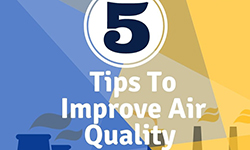
Here are 5 things you can do to improve air quality in your home and community:
- Vacuum your home regularly. Vacuuming is a great way to improve air quality in your home by removing dust and particles from your carpets and floor. This reduces the amount of dust that could circulate through the air in your home.
- Change your air filters. Our homes are filled with everyday equipment that uses filters, these filters collect dust and other allergy causing particles. AC systems, clothes dryers, vacuum cleaners, and bathroom vents are just a few examples of household equipment that have filters. Changing your filters will greatly reduce air pollutants in your home and reduce potential health risks.
- Invest in a snake plant or two. Indoor plants are a great way to spruce up your home office or bedroom while removing toxins from the air. Snake plants are easy to care for (they don’t require much watering) and improve air quality by removing toxins that come from cleaning products and aerosols. There are plenty of other indoor plants that also improve air quality. However, if indoor plants just aren’t your thing, and if you want an excuse to go to Target, you can always buy an air purifier for your home.
- Take a walk. Cars are a major source of air pollution. Taking an opportunity to walk or ride your bike somewhere is a step towards improving air quality in your community. Look for opportunities to use your car less such as walking across a shopping center instead of driving to the other side. Or, if it’s an (safe) option, try carpooling or taking public transportation. You will also benefit from the extra exercise.
- Stay smoke free. Smoking, whether in your home or in your community, greatly reduces air quality. Smoking in your home is dangerous for your entire household because it is an enclosed area. The toxins from tobacco smoke are very difficult to remove from your home because they easily settle into furniture and air filters, which allows them to remain for a long time in your home. Click here if you or someone you know would like some resources to quit smoking.