

Department History
History
For over a century, the Department of Kinesiology has been a cornerstone department of the University. Beginning as the Department of Physiology and Physical Culture in the Women’s College in 1892, the department took the progressive view that women should be physically active to improve their health and wellness. As the department evolved and grew with the university, our name changed, but our mission to promote education in and instruction of physical health remained at our core.
Explore the interactive timeline to see highlights of our history.
Department Timeline

Uncg Founded
The University of North Carolina at Greensboro was established by legislative enactment on February 18, 1891. The institution opened on October 5, 1892 with a student body of 198 and a faculty of 15 – and the final enrollment reached 223 at the end of the first year. Classes were organized in three departments: commercial, domestic science, and pedagogy. It was known first as the State Normal and Industrial School, and after 1897 as the State Normal and Industrial College until 1919. During the period 1919-1931, it was known as the North Carolina College for Women.

Early Physical EDUCATION
From 1907-1925 the indoor college gymnasium was located in South Spencer Hall. Before that, the Department of Physical Education had no gymnasium, only a game room in South Spencer.

Mary Channing Coleman
Mary Channing Coleman: Head and founder of the Department of Physical Education. Shortly after her arrival at NCCW in 1920, Coleman instituted a physical education major program and planned the first physical education facilities. From then until her death in 1947 Coleman built up a department of national renown – one of the leading places in the country to train women physical education teachers. Learn more about Coleman.

Division / Department of Physical Education
The Division (later Department in 1935) of Physical Education was formed in 1921, with Mary Channing Coleman as head. Under Coleman’s leadership, the physical education major program started that year, with an outdoor gymnasium as its first education faculty. In June 1926, nine graduating seniors received the B.S. in physical education.

Rosenthal Gymnasium Built
Rosenthal Gymnasium, home of the Physical Education Division, opened on campus in 1925. The building is now referred to as the Rosenthal Annex.

Women’s College (WC) Becomes Part of the University of North Carolina
The General Assembly of 1931 combined the North Carolina College for Women, The University of North Carolina (at Chapel Hill) and the North Carolina State College of Agriculture and Engineering (at Raleigh) into a single Consolidated University. The campus at Greensboro thus became The Women’s College of the University of North Carolina. It is warmly remembered as the “the WC” by its many alumnae of the period from 1931-1963.

Ethel Martus Lawther. “Martus Era” Begins.
Ethel Martus joined the physical education faculty in 1931, and became Head on Coleman’s death in 1947. Marthus was instrumental in developing graduate programs and making UNCG one of the top physical education programs in the country. She became the first Dean in 1971 when the department became the School of Heath, Physical Education and Recreation. She married John Lawther, professor emeritus from Penn State, shortly after. Ethel Martus Lawther retired in 1974 after 43 years on the faculty. Read Dean Lawther’s “random thoughts” in the Winter 1974 Alumni News about her time at UNCG along with recollections of several alumni of that time.

Coleman Gym Opens
Coleman Gym opens on campus in 1953. It (and the Rosenthal Gym) became part of the Health and Human Performance Building in 1989. The HHP building was re-named as the Coleman Building in 2015.
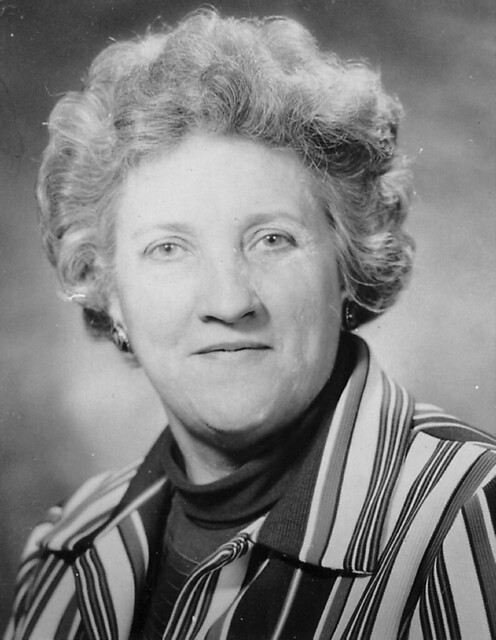
Celeste Ulrich
An alum of WC and Faculty Member from 1956-1979, Ulrich shared her experiences watching the department grow and change as an alumna and professor emerita of UNCG at the alumni breakfast in 2006. Read Ulrich’s thoughts as she watched the department grow.
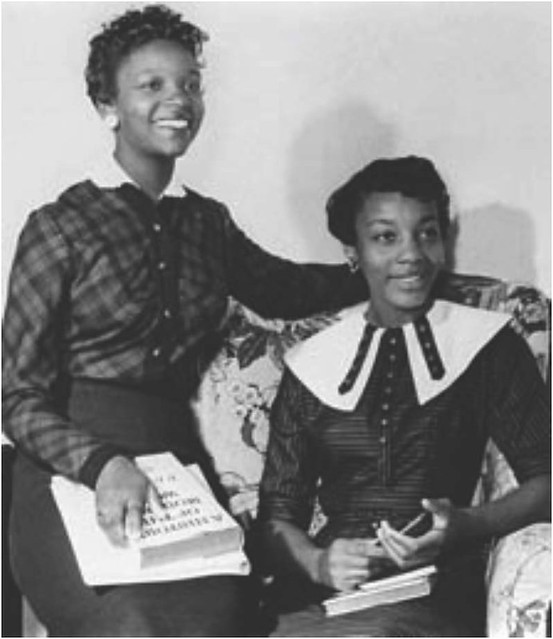
First African American Student Admitted
JoAnne Drane (on right) and Bettye Tillman entered in 1956.

Woman’s College Becomes the University of North Carolina at Greensboro and Co-Educational
In 1962, the Board of Trustees recommended that the Greensboro campus become coeducational at all levels of instruction. Subsequently, by act of the General Assembly in the spring of 1963, the name of institution was changed to The University of North Carolina at Greensboro. Men were first admitted as part of the general student body in 1964.
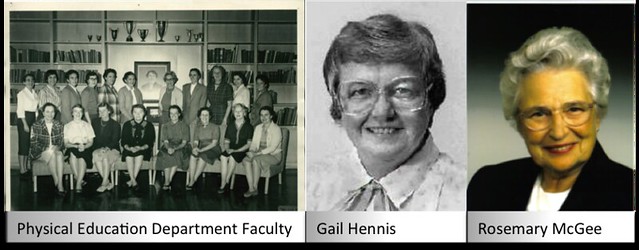
Start of the DOCTORAL (Ed.D) Program
The first doctoral program in what is now called kinesiology was an Ed.D. program, first offered in 1966.
Start of the Doctoral (Ed.D.) Program
Martus hired faculty with doctoral degrees – Celeste Ulrich, Rosemary McGee, and Gail Hennis were instrumental in designing and implementing all graduate programs on the UNCG campus. Prior to the establishment of the Ed.D., graduate degrees offered included the MFA (dance in PE) in 1947, M.Ed. in physical education in 1951, and the M.S. in 1959. To learn more about people and programs, check the oral history project interviews, including former faculty: Rosemary McGee, Celeste Ulrich, E. Doris McKinney.

New Faculty-new Programs
Kate Barrett and Pearl Berlin were the first two faculty members to be hired to specifically develop new programs. Dr. Berlin was charged with helping the department faculty engage in increased research activity, and Dr. Barrett developed an undergraduate and graduate emphasis on physical education – teacher education in close partnership with the K-6 public schools.
New Faculty-new Programs
E. Doris McKinney, who focused on psychology and motor behavior, also joined the faculty at this time. Dr. McKinney was the first African-American faculty member in the department, and one of the first on campus. At the same time that emphasis was increasing on research and graduate education, the department maintained its commitment to undergraduate physical education, primarily under the leadership of faculty members Betsy Umstead and Marge Leonard.
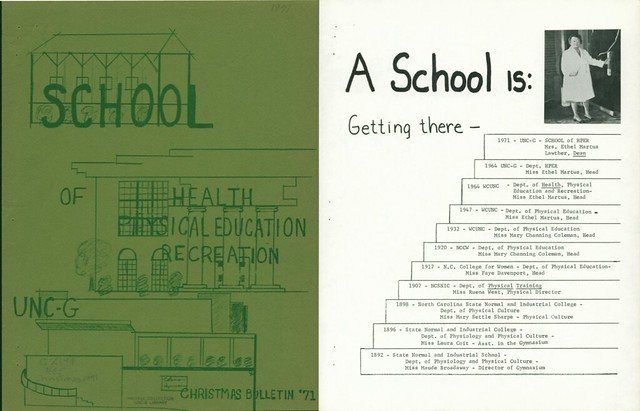
Establishment of School of HPER
Ethel Martus Lawther became the first Dean of the new School of Health, Physical Education, and Recreation in 1971, and served until her retirement in 1974. Margaret Mordy served as Dean 1974-1979.

Dick Swanson
Richard (Dick) Swanson served as Dean 1980-1992. In 1990 the school changed its name from School of Health, PE, Recreation, and Dance to the School of Heath and Human Performance. Dr. Swanson returned to the department as Professor and scholar in sport history from 1992 until his retirement.

Shirl Hoffman
Shirl Hoffman came to UNCG as Department head in 1986. During his 10-yer tenure as department head, several faculty were hired as specialists in sub-disciplinary areas, and the doctoral program moved from the Ed.D. to a Ph.D. program (started in 1987) with specialized concentration areas (Exercise Physiology, Biomechanics, Sport & Exercise, Pedagogy). Later, in 1996, Dr. Hoffman was instrumental in re-establishing the Ed.D. program as a professionally-oriented doctoral program in kinesiology.
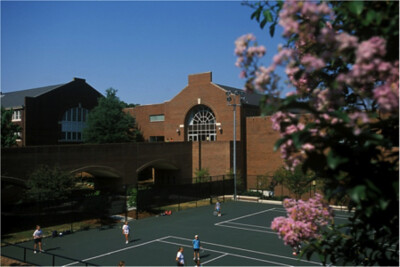
HHP Completed
The Health and Human Performance Building was completed in 1989. Rosenthal Gymnasium and Coleman Gymnasium were incorporated into the new HHP building. In 2015 the HHP building was re-named as the Coleman Building.

Department of Exercise and Sports Science
In 1989, Department of Physical Education changed its name to the Department of Exercise and Sport Science.

Dedication of the HHP Building
Photo includes Rosemary McGee, Margaret Mordy, Dick Swanson, and Ethel Martus Lawther (Former deans) at the dedication ceremony.
Department of Kinesiology
The department changed its name from Exercise and Sport Science (ESS) to Kinesiology (KIN).

UNCG and Kinesiology Today
The Department of Kinesiology has over 600 undergraduate majors, master students in Human Movement Science, Exercise Physiology, Community Youth Sport Development, Motor Behavior, Pedagogical Kinesiology, Sport and Exercise Psychology, and Sports Medicine concentrations, as well in the MSAT in Athletic Training. The department has Ph.D. students in Human Movement Science, Exercise Physiology, Pedagogical Kinesiology, and Sport and Exercise Psychology, and the new (2014) Ed.D. online program.
The department expanded to the Department of Physical Training in 1907 and then to the Department of Physical Education in 1917, a name that would stand for 72 years. Graduate programs first appeared in 1951 with the addition of a Master’s of Education (M.Ed.) degree, which was followed by a Master’s of Science (M.S.) degree in 1959 and doctoral degrees in 1966 (Ed.D.) and 1987 (Ph.D.). The Department of Physical Education became the Department of Exercise and Sport Science in 1989 to reflect its broader and deeper academic mission. On March 26, 2009 the department name was changed to the Department of Kinesiology. The department currently offers B.S., M.S., M.S.A.T., Ed.D., and Ph.D. degrees.
Throughout its history, the department has contributed to the growth of the field of physical education, and now to the broader field of kinesiology, producing award-winning teachers, leaders, and scholars. The history of the department and of various professional organizations in the field of kinesiology shows the tremendous impact current and former faculty have had on the field, and the success of our alumni as physical education teachers, researchers, athletic trainers, fitness professionals, community youth development professionals, and much more.
The students and faculty of the Department of Kinesiology recognize that our current and future success is built on our legacy of accomplishments. Our students and faculty are continually motivated by this legacy, one that encourages a willingness to take bold chances and make conscious, continuous efforts to develop a strong sense of community, within our department, the communities we serve, and the greater field of kinesiology. By embracing our trailblazing past and looking ahead to the future, the Department of Kinesiology continues to be a leader both in our institution and in our field.
You can learn more about the Department of Kinesiology’s beginnings and evolution as a forward-thinking foundational pillar of the University.