


More than a hundred years ago, a German psychiatrist named Dr. Alois Alzheimer made an important discovery about a disease that would later bear his name. This discovery helped us learn more about the disease and laid the foundation for subsequent research and treatment.
The Mysterious Patient: In 1901, Dr. Alzheimer met a middle-aged woman named Frau Auguste Deter at the Frankfurt Asylum in Germany. She was not like other patients; she was suffering from symptoms that defied conventional medical explanations. She experienced severe memory loss, confusion, and behavioral changes. Dr. Alzheimer was curious about her condition and began observing and documenting her symptoms to better understand what was happening. This led to a big breakthrough.

Photo: Dr. Alzheimer’s handwritten medical file for Deter
The Final Examination That Showed the Truth: As time went on, the patient’s condition got worse, and she eventually passed away in 1906. Dr. Alzheimer looked at her brain during a post-mortem examination and uncovered distinct abnormalities. He found the presence of tangled nerve fibers and unusual protein deposits, now recognized as amyloid plaques and neurofibrillary tangles. These discoveries helped him understand more about what was happening inside her brain.
A New Disease is Named: Dr. Alzheimer’s discovery became the foundation for studying this disease. Scientists wanted to understand, diagnose, and treat this devastating disease. In 1910, a psychiatrist who worked with Dr. Alzheimer, Dr. Emil Kraepelin, named the disease “Alzheimer’s disease”. It was published for the first time in Germany in volume two of the book General Psychiatry.
Legacy and Ongoing Research: Dr. Alzheimer did not stop at his initial discovery. He wrote many papers about the brain and how it works. His research helped people understand more about Alzheimer’s disease. He laid the groundwork for future generations of scientists, who have built upon his findings, advancing our understanding of Alzheimer’s disease. For example, scientists have learned more about genes and created better machines to look at the brain. With these advances, doctors can detect the disease earlier and develop new treatments. Ongoing research, inspired by Dr. Alzheimer’s work, strives for effective treatments and prevention strategies, and ultimately, a cure.
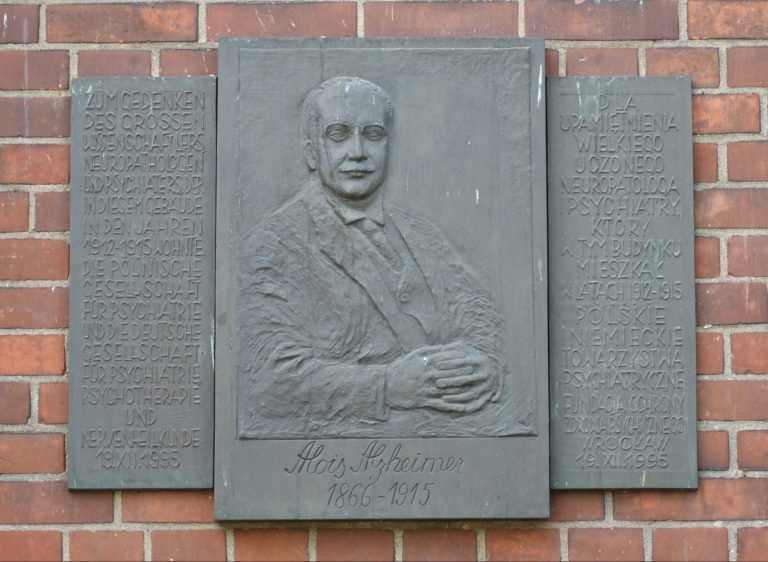
Image: Monument on Dr. Alzheimer’s former home, Villa of Wrocław
Dr. Alzheimer’s extraordinary discovery of Alzheimer’s disease has forever changed the medical world. His research helped us understand the disease better and find ways to help those affected. As scientists and healthcare professionals build upon his work, we continue to see new discoveries that improve the lives of those affected by Alzheimer’s disease.